

Your child knows it’s just a costume, so why are they still scared of Halloween? A developmental psychologist explains why Halloween fears can be a sign of growth.
By Tess Shirefley, PhD, Developmental Psychologist, Child Development Professor, and mom of three
TL;DR
- A child can know that a Halloween costume is pretend and still feel genuinely scared. Knowing something isn’t real doesn’t automatically make it feel safe.
- Halloween fears don’t always decrease as children get older. As kids develop, their fears often shift from what something looks like to what might actually happen.
- A child who was fine with Halloween last year and scared this year isn’t regressing — their growing understanding of the world is actually what’s making it feel scarier.
- Meeting basic physical needs before trick-or-treating — food, rest, water — gives children the best chance of managing big feelings in the moment.
- Giving children a plan and a sense of control (“you can hold my hand, step back, or leave”) is more effective than forcing participation or avoiding Halloween altogether.
- Children don’t need to be shielded from scary feelings. They need a trusted adult to help them work through those feelings at a pace that feels manageable.
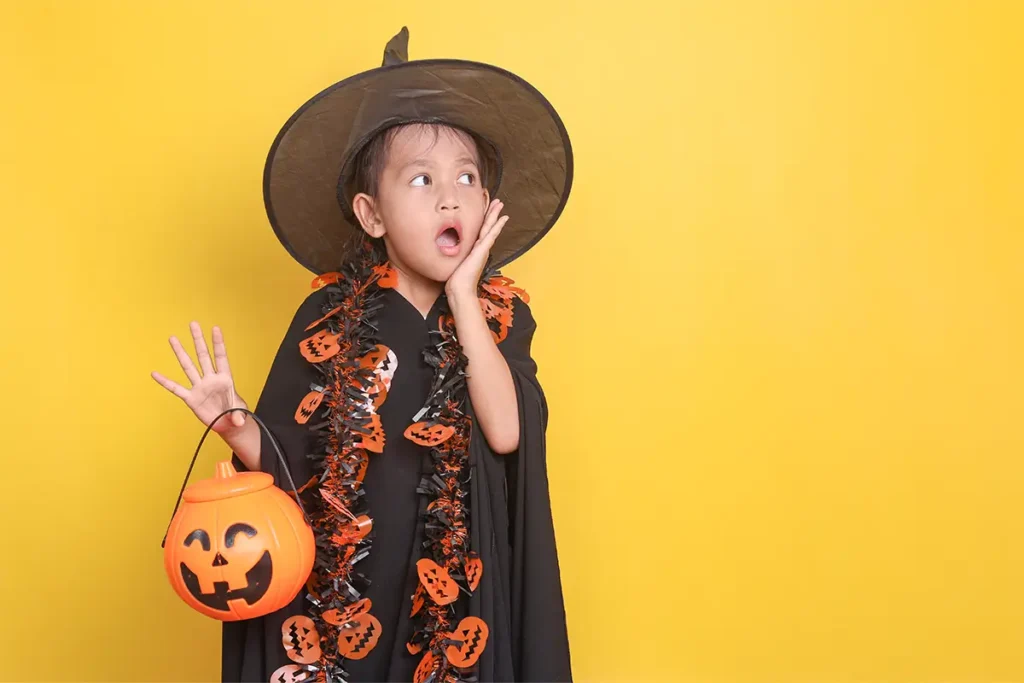
Photo: iStockPhoto (Rani Nurlaela Desandi)
The season is upon us! The air is getting cooler, the sun is setting a little earlier, and you can’t avoid the aisles and aisles of candy at the stores. A fellow parent and I were recently talking about how fun this time of year can be as children eagerly anticipate the big day.
But this parent shared something that happened last year: their 9-year-old did not want to go trick-or-treating because Halloween felt too scary. This surprised them. Their child had participated in Halloween before and had really enjoyed it in previous years. So what had changed?
As a developmental psychologist, my response was simple but rooted in lots of rich developmental science: “Sometimes growing up doesn’t look very linear.”
As parents, we often expect our children to gradually “grow up” and become more like us. We expect them to be more independent, more capable, and better able to understand the world around them. And, in some ways, that is exactly what happens. As children get older, they become increasingly able to distinguish reality from make-believe, real from not real.
But understanding that something is pretend does not automatically stop it from feeling real. A child can know that a costume is not actually a monster and still feel frightened when that “monster” walks toward them. In fact, as children develop a more realistic understanding of the world, they may also become more aware of the things that could happen in real life. Their fears can change, deepen, or even become more intense before they become easier to manage.
In this post, we will unpack when and how children develop an understanding of reality versus pretend, explore why growing older does not always mean feeling less afraid, and discuss how caregivers can support children as they manage these big feelings. With the right support, children can find ways to enjoy special, and sometimes spooky, days like Halloween.
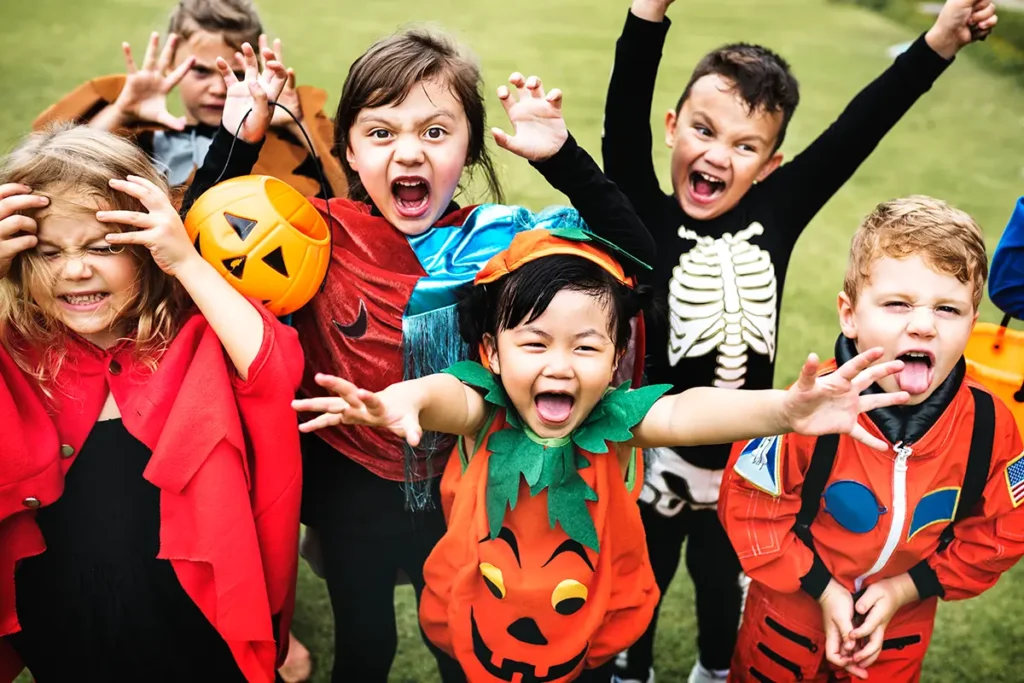
Photo: IStockPhoto (Rawpixel)
Why Does My Child Know It’s Pretend But Still Feel Scared?
Knowing something is pretend is a thinking skill, but feeling safe is an emotional response, and the two don’t always develop at the same pace.
As children’s cognitive abilities grow, so does their capacity to understand the difference between what is real and what is pretend. But the foundations of this understanding begin surprisingly early. In a study of children between 15 and 26 months old, researchers compared toddlers’ responses to matching real and pretend play scenarios. In one example, an experimenter either really filled a cup with water or pretended to fill an empty cup. The child was then asked to choose the cup that contained water. Even the youngest children in the study who were less than two years old could recognize the difference between the real and pretend versions of simple actions.
We see this basic understanding bloom into the cornerstone of early childhood: make-believe and pretend play becomes something similar to everyday play. Pretend play requires children to hold two ideas in mind at once: this object is one thing in reality, but we are treating it as something else for the purpose of play. This is why we see that toddlers can engage with a play kitchen, pretend to cook food, and act as if they are eating, all while understanding that the plastic food is not actually something they can eat.
Children’s understanding of pretend and make-believe becomes more nuanced as they get older and begin reasoning about what is possible in the real world. This then leads to the more critical evaluations of things as being real or not real. Consider dinosaurs. My son understood that dragons, unicorns, and mermaids were creatures created in stories rather than real animals. So one day he tells me “Dinosaurs aren’t real, they’re just pretend”. Interesting. In many ways he’s wrong, but he’s also kind of right. Dinosaurs are giant like dragons, no longer exist today, and can seem just as fantastical as other pretend creatures, yet they were real creatures that once lived on Earth.
Halloween can be exciting for children, but costumes, decorations, crowds, and spooky characters can also feel overwhelming. Children’s understanding of real versus pretend develops gradually, and growing older does not always mean feeling less afraid. Stories, shows, games, and Calling All Kids’ Halloween content can also help families talk about scary characters, pretend worlds, and managing big feelings.
This kind of distinction was actually explored in a seminal developmental psychology study by Morison and Gardner in 1978. They asked children from kindergarten through sixth grade to sort pictures of real and fantastical figures and explain how they had grouped them. The researchers found that children became increasingly able to use and explain fantasy-versus-reality categories as they grew older. However, children did not always organize their thinking around this distinction. Their responses were also influenced by a character’s appearance and power source highlighting how sometimes a simple real vs not real distinction is more complex.
Together, these studies suggest that children do not suddenly wake up one day with a fully developed understanding of reality and pretend. Instead, they gradually build this understanding through play, experience, conversation, and learning about how the world works. Their thinking may also be more nuanced than a simple “real” or “not real” answer suggests, since the world even for adults to understand is pretty complex.
That complexity is exactly where Halloween fits in. Everyone is in costumes, pretending to be something else. However, sometimes these costumes are rooted in reality (e.g., dressing up as a doctor) and sometimes they are fantasy (e.g., a vampire or mermaid). Also, sometimes our decorations are real things like spiders or blood, but they are displayed in ways that aren’t normal real-world sightings (e.g., my giant fuzzy spider from HomeGoods currently guarding my front lawn).
This is all to say, that the lines get blurry for a child of any age. And it is important to remember that even when a child can understand that something is pretend does not automatically make it feel unscary. In the next section we unpack how children’s fear may shift with age and why Halloween may trigger very real fear responses even though they know it is all pretend.
 Photo: iStockPhoto (kdshutterman)
Why Does My Child Seem More Scared of Halloween Than Last Year?
As kids grow, their fears shift from what a costume looks like to what might actually happen, so a newly scared child isn’t regressing, they’re developing.
It might seem logical that as children become better at understanding what is real and what is pretend, they would become less afraid of Halloween. If a child knows that a costumed dragon is actually a person, then shouldn’t the costume lose its power?
Sometimes it does. But development is rarely that straightforward.
As children grow, their fears often change along with their understanding of the world. A younger child may be frightened by the immediate appearance of a mask or costume because it looks unfamiliar or because they are unsure whether the character is real. However, an older child may understand perfectly well that the costume is pretend, but still feel nervous about what the costume represents, or about the real-world possibilities surrounding Halloween. They may worry about getting lost, being startled, encountering unfamiliar people, being judged by peers, or not knowing what will happen next.
Developmental research has confirmed that what children fear changes as they get older. Several studies have shown that older children don’t fear less, but rather what they fear shifts. For example, some research conducted in 2014 found that younger children tend to experience more immediate and concrete fears, while older children become increasingly capable of anticipating abstract or future fearful possibilities. In other words, as kids get older, during Halloween they may fear less about what something is and more about will something happen to me?
Emotional development can also affect how children distinguish between fantasy and reality. Research with preschoolers has found that frightening events can influence children’s judgments about whether something could really happen. When children feel strong fear, they may have more difficulty calmly reasoning through what is real and what is pretend.
This helps explain why fear may ebb and flow across childhood. A child may enjoy Halloween one year and feel frightened the next, not because they have moved backward, but because the experience has changed meaning for them thanks to their new cognitive and emotional skills. Their developmental level and growing awareness of the world can shape how the scary parts of Halloween feel in that particular moment.
If you’d like to understand more about what’s happening in your child’s brain and body during these overwhelming moments, my post on emotional regulation in young children goes deeper.
Now that we understand how children learn to distinguish between real and pretend, and why cognitive growth does not always make fear disappear, we can turn to the final question: How can we, as caregivers, support children through the big feelings that come with Halloween?
 Photo: iStockPhoto (wichayada suwanachun)
How To Help Your Child Who Is Scared of Halloween
Make sure your child is fed and rested, give them a plan they help create, and use stories and shows to talk through scary feelings ahead of time.
As we reviewed above, thanks to children’s evolving cognitive and emotional complexities a child can know that a person in a ghost costume is not actually a ghost and still feel frightened when that “ghost” comes near them. Knowing something is pretend is a cognitive skill, but feeling safe in the presence of something scary is an emotional and physiological process.
These abilities develop together, but they do not always move at the same pace.
That is why supporting children through Halloween is not just about explaining what is real and what is pretend. It is also about helping them understand and manage the very real feelings that can arise when pretend things look, sound, or feel frightening.
It’s important to remember that every child is different and may handle coping with their fear differently, but here are three tips I’d encourage you to try this Halloween if your child is struggling with their fears.
Tip 1. Get Kids on Solid Ground Before Facing Their Fears
Halloween is every parent’s perfect storm of chaos. Hyped up energy, big crowds, late night, and that horrible, horrible thing…candy. The best way we can prepare our kids to manage their big feelings in the moment is to prepare their bodies in advance.
It’s basic psychology: we can’t handle our big feelings if we are hungry or tired. So do your best to ensure your kids have had nice big meals (or in my kids’ case, 25 different snacks), have rested or at least had some down time, and have a water bottle on hand while tackling Halloween. Meeting these basic needs first will help give your kiddo the physical energy needed to try and cope with those terrors and frights of the night.
Tip 2. Give Your Child the Power to Plan
As caregivers, we are often fixers. When our children become scared, our first instinct is to make the feeling go away and make everything right for them. Sometimes, though, children need us to step back from fixing the problem and help them find their own way through it.
A few years ago, my children and I attended a trunk-or-treat event at a local college. The school mascot (weirdly enough a giant otter) was there, and my then-three-year-old noticed it the moment we walked in. He immediately showed signs of discomfort. Rather than insisting that he say hello or rushing him away, I helped him think through his options. We talked about what he could do if he began to feel overwhelmed: stay close to me, move farther away, watch the mascot from a distance, or leave the area altogether. At three, he needed my support to create that plan.
Now that he is almost five, we regularly work together to develop plans for different situations:
- “If I don’t like the food at school, I can eat my snack.”
- “If I can’t pick a snack at Target today, maybe I can next time we go.”
- “If I don’t understand the rules, I can ask my teacher.”
- “If I feel scared, I can hold your hand or take a break.”
Giving children the opportunity to create a plan that works for them, and ideally for the family, helps them experience a sense of control in situations that might otherwise feel out of control. It also gives them a way to channel fear into action. We are still there to offer support, and in many cases help rein in their sometimes-unrealistic solutions, but we are helping children learn that they have options and can participate in deciding what happens next.
This is especially important during Halloween, when children may encounter unfamiliar costumes, decorations, crowds, and sounds. They do not have to simply join in or completely opt-out. The goal is to help them find a level of participation that feels manageable and based on their own choice. Hopefully this helps set the tone for the evening and can help them to build confidence in their ability to respond when something feels like too much.
Tip 3. Talk About Fears Using Media
What I hope the research discussed above shows is that children are highly capable of building a nuanced understanding of the world. As caregivers, we can lean into the fact that the world is complicated while trusting that we have the tools to help our children make sense of it.
Books, television shows, games, and pretend play can all create opportunities to talk about what is real and what is pretend, while also helping children process feelings of fear or worry. When something in a show scares my children, I almost never turn it off or skip ahead. Instead, I pause and talk with them about what feels scary. I might ask, “What part of that felt frightening?” or “Do you think that was real or pretend?” I validate their response and let them know that I understand why the scene felt scary. Sometimes I even share that I have had similar feelings.
Then, when they are ready, I encourage them to make a choice. They can continue watching and find out how the story unfolds (I usually push for this one a little more to show them resolution usually comes), or they can take a break, walk away, and try something else. The important part is that I am not forcing them to keep watching or trying to convince them that they should not be scared. I am helping them notice their feelings, understand what is happening, and decide what they need next.
Giving children opportunities to encounter manageable moments of fear and work through those feelings with a supportive adult can help them feel more prepared when they encounter especially frightening experiences, like Halloween.
One way to begin these conversations is through stories. This is why I worked with the Calling All Kids app to develop some fun Halloween stories that engage kids while offering opportunities to talk about Halloween characters and pretend worlds. We also developed a Halloween call focused specifically on real versus pretend and managing feelings of fear if you would like some support getting that conversation started with your child. Sometimes a story is all we need to turn a spooky moment into an opportunity for growth with our kids.
Frequently Asked Questions
Why is my child suddenly scared of Halloween when they weren’t before?
As children grow, their understanding of the world becomes more sophisticated — and so do their fears. A younger child may have been startled by a costume’s appearance, while an older child may now worry about what the costume represents or what might actually happen during the night. This isn’t regression. It’s development.
Why does my child know it’s not real but still feel scared?
Knowing something is pretend is a cognitive skill. Feeling safe in the presence of something scary is an emotional and physiological process. These two abilities develop on different timelines, which means a child can fully understand that a ghost costume is just a person in a sheet and still have a very real fear response when that “ghost” walks toward them.
How do I know if my child understands real versus pretend?
Most children begin distinguishing reality from make-believe as toddlers, and that understanding becomes more nuanced as they grow. If your child engages in pretend play, treats toy food as pretend, or can tell you that a cartoon character “isn’t real,” they have the foundations of this understanding. The question is rarely whether they understand — it’s whether that understanding is enough to override a fear response in the moment.
Should I force my child to go trick-or-treating if they’re scared?
No, but avoiding Halloween altogether isn’t always the answer either. The goal is to help your child find a level of participation that feels manageable and is based on their own choice. Give them a plan, give them options, and let them lead. A child who watches from the driveway this year may be ready to walk the block next year.
How do I help my child with Halloween fears?
Start with the basics. Make sure they’re fed, rested, and hydrated before heading out. Then give them a plan for what to do if something feels like too much: hold your hand, step back, take a break, or leave. Finally, use books, shows, and pretend play in the days before Halloween to open conversations about scary characters and big feelings in a low-stakes environment.